Politics
Russia's truck maker KAMAZ dominates the market -- and is going broke
Russia's largest truck maker grew its market share and still lost a fortune -- a warning sign for the whole wartime economy.
By Sultan Musayev |
Russia's biggest truck maker is supposed to be a wartime success story. Instead, KAMAZ is hemorrhaging cash, cutting jobs and burning through more than a decade's worth of retained earnings in just over a year.
The contradiction sits at the heart of the company's first-quarter 2026 results. KAMAZ grew its share of the Russian heavy truck market to 32.9%, up from 30% a year earlier, helped by government barriers against Chinese competitors and a collapse in imports.
But that bigger slice came from a shrinking pie: sales fell 14% and production dropped by a third. KAMAZ sold 3,900 new trucks in the first quarter, down from 4,500 a year earlier. The broader Russian truck market collapsed 30% in January-March compared with the same period last year, on top of a 54% plunge in 2025.
A decade of profit, gone
Falling revenue pushed KAMAZ to a net loss of 37 billion RUB ($494 million) last year -- 11 times worse than in 2024. The losses kept piling up in the first quarter of 2026, topping 9 billion RUB ($120 million).
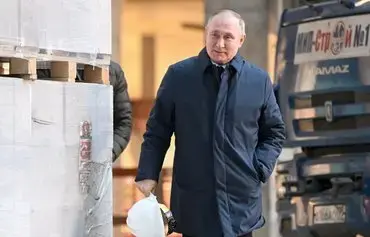
![Russia's President Vladimir Putin (R) and Deputy Prime Minister Marat Khusnullin talk to each other inside a Kamaz truck at M12 Vostok Highway in the Tatarstan Republic on February 22, 2024. [Alexander Kazakov/POOL/AFP]](/gc6/images/2026/06/26/56783-afp__20240222__34ju2qy__v1__highres__russiapoliticsputin-370_237.webp)
The most alarming number for shareholders and creditors is how fast the company's cushion disappeared, according to Business Gazeta. KAMAZ's retained earnings stood at a positive 22 billion RUB ($294 million) on December 31, 2024. By March 31, 2026, just 15 months later, that figure had collapsed to negative 24.3 billion RUB (negative $324 million).
That swing means KAMAZ burned through more than 46 billion RUB ($614 million) of previously banked earnings in little more than a year, the outlet reported, casting doubt on any future dividend payments.
KAMAZ isn't promising a turnaround soon. CEO Sergey Kogogin told reporters at the Russian Union of Industrialists and Entrepreneurs congress in late March that the company's goal for this year is simply to break even.
Debt is squeezing the company from another direction. KAMAZ paid almost 10 billion RUB ($134 million) in interest in the first quarter alone, roughly a fifth of its entire quarterly revenue. Total debt from credits and loans, not counting leases and other liabilities, reached 262.4 billion RUB ($3.5 billion) at the end of March, up 19% over the year.
The financial strain has already cost jobs. KAMAZ cut about 500 positions in April and another 1,500 in May, according to media reports. Investors have responded accordingly: the company's shares fell 47% between June of last year and June 10 of this year.
Defense contracts, diminishing returns
The slump runs counter to the Kremlin's narrative that the war has powered the Russian economy, creating jobs and pushing defense plants to record output.
Saule Tulegenova, an expert at the Center for Economic Research in Astana, said KAMAZ should be thriving as a key military asset benefiting from state budget injections. Instead, companies like it serve defense needs on margins so thin they don't even cover inflation. They have little choice, since refusing military orders isn't an option, she told Kontur.
"Essentially, the state defense contracts are pulling KAMAZ to the bottom. Working in the civilian market in peacetime was much more profitable," Tulegenova said.
Sanctions, disrupted supply chains and rising costs are compounding the pressure, Tulegenova said. Meanwhile, high interest rates have made commercial leasing nearly unaffordable for would-be buyers.
Kogogin made a similar point directly to President Vladimir Putin in May, telling him that before the war, KAMAZ had been deeply integrated into the global auto industry. Sanctions forced the company to cut ties with European partners, including Germany's Daimler, which had held a 15% stake.
Olga Shestakova, an entrepreneur who relocated from Moscow to Almaty in 2024, told Kontur that KAMAZ's struggles reflect the broader state of Russian manufacturing. If the country's largest truck maker and a core defense contractor is drowning in debt, she said, that signals deep trouble for the wider economy.
"If even these giants are sinking, what hope is there for small and medium-sized businesses? We are all in survival mode right now," Shestakova said.
She added that the same pressures facing KAMAZ extend to dozens of other strategic Russian defense and industrial enterprises that were once profitable.
On the battlefield, KAMAZ trucks remain essential. They transport troops, haul supplies, tow artillery and serve as platforms for weapons systems — work that pro-war bloggers say ties the company's financial health directly to Russia's military capacity.
Independent analysts warn that total militarization, and the priority placed on government orders over profit, could permanently erode the competitiveness of KAMAZ and other Russian firms that have shifted to a wartime footing.
KAMAZ appears headed further down that path. Kogogin told Putin in May that the company plans to begin producing armored personnel carriers next year.